


In this article, we will avoid parochialism for our products but rather try to give you those indispensable tools to understand how to recognise a low-quality coffee from a high-quality one. On its own, the low selling price is often not enough, even though it usually equates to a poor quality product. Many factors influence the quality of a high-end coffee: we need to understand which variety of coffee we are buying, the blend and the roasting defined during the cooking process; and which method of preservation was used, and how long the product was stored in the warehouse.
How, then, to choose a high-quality coffee or the best coffee?
As we said before, choosing the best coffee is not easy, but we can understand what we are buying by checking a few indicators on the label.
Therefore, learning to recognise a high-quality coffee is not only desirable but rather a real necessity for a coffee lover.
Below we will list what we consider to be the most critical factors for recognising a quality coffee, obviously to be tested without sugar:
- roasting;
- foam;
- aroma;
- taste;
- aftertaste.
How a good coffee should be roasted
According to us at Caffè Cannizzaro, the first element that you need to analyse when choosing a high quality coffee is its roasting. We have already discussed this in another article:
an excessive dark roasting of the coffee beans penalises the organoleptic components inside each bean. It this stage, by analysing the coffee colour, you can understand the roaster’s choices: a light roast, with a light brown bean, will tend to preserve the more delicate notes of the seed, whereas an over-roasted bean will give a bitter coffee with an overly intense taste.
At this stage of our analysis, it is also possible to understand the type of blend used by the retailer. Pay attention to the beans’ shape: a fine Arabica has an elongated body, and it is quite large; differently, a modest Robusta is smaller in size and rather rounded. In general, the axiom applies that the larger and longer the bean, the higher the quality of the coffee blend used.

There are three types of coffee roasting:
1) light roasting – This is used for soft, acidic coffees, rich in floral and fruity notes. These are single-origin coffees, prepared using filter extraction methods;
2) medium roasting: it’s a type of roasting suitable for a well-rounded, balanced, full-bodied coffee with a relatively broad aromatic spectrum;
3) dark roasting: suitable for a full-bodied and bitter espresso, characterised by a marked acidity and a reduced caffeine quantity.
The cream of a good espresso
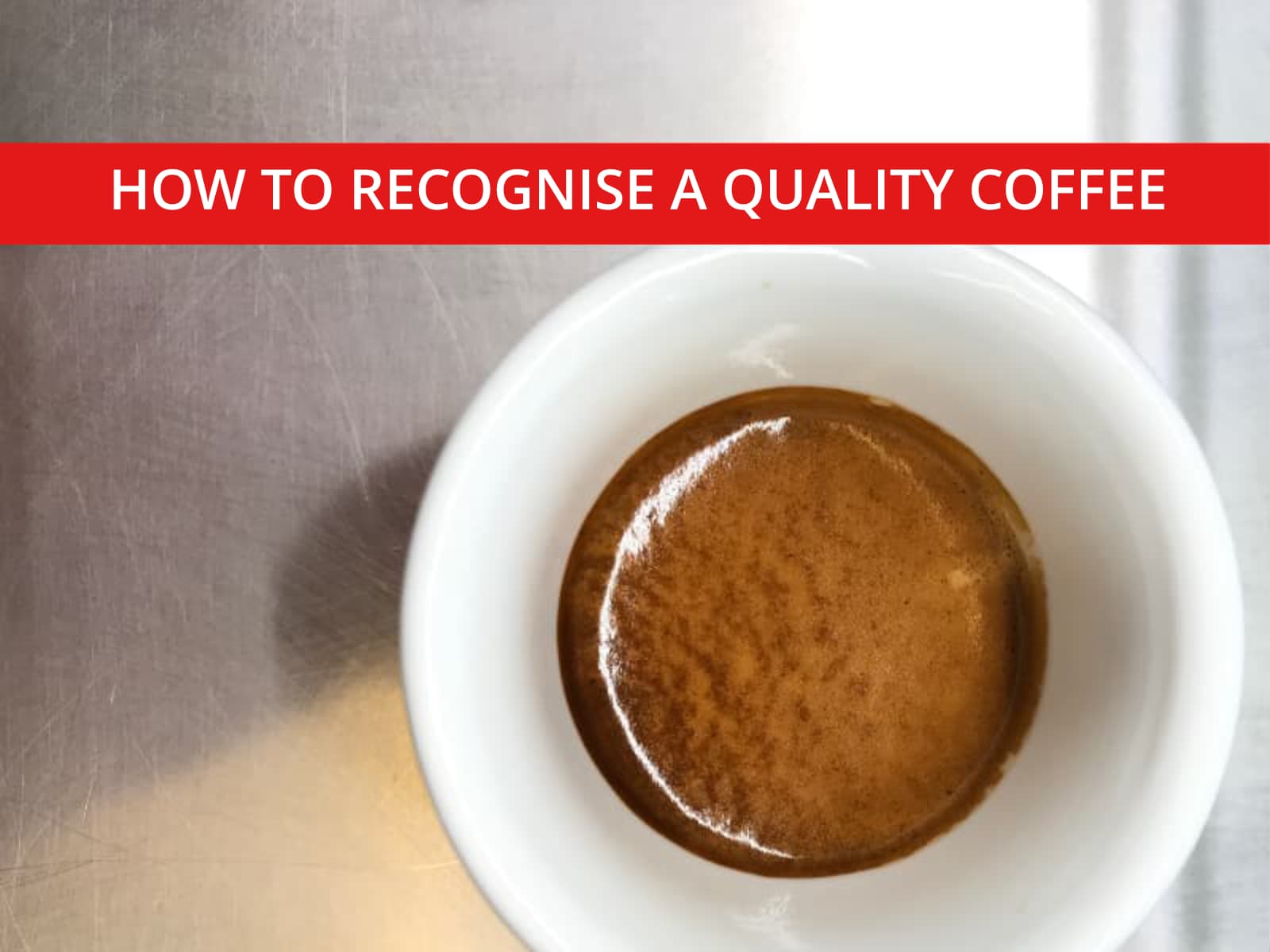
Before proceeding to taste espresso, you need to pay attention to the cream that forms on the surface: in a good cup of coffee, it usually is smooth and thin but consistent. The cream’s thickness in a high-quality coffee is just a few millimeters, and the colour is medium-dark brown.

The unique aroma of good coffee
It is not the method of brewing the coffee that is important, but rather that it gives a rich, varied and complex aroma in the cup. The olfactory notes need to be balanced, giving our nose a round and elegant sensation.
At first glance, it will not be easy to recognise the aromatic notes that a good coffee releases, but we promise that, with practice, you will be able to notice all the nuances that a proper roasting brings out in each bean.
You will recognise the scent of dried fruit, bread, and the scent of cedar or sandalwood, tobacco, chocolate, caramel, or fruits. On the other side, an incorrect roasting does not bring out these delicious aromas, making only the typical burnt smell predominant, which many excessive dark beans often bring with them into espresso.


The taste: the balance between bitter, acidic, and sweet
When tasting a good coffee, you immediately notice the perfect balance of bitter, acid and sweet. It is precisely these three flavours that an excellent raw material and optimum roasting put in ideal harmony.
One of the factors that can affect this balance is the coffee blend chosen at the roasting stage: a strong presence of Arabica could push the taste more towards excessive acidic notes, while Robusta’s excessive presence could push it towards intense and bitter notes.
When choosing a coffee brand, it is essential to consider these four factors: acidity, aroma, body, and flavour.
The acidity is a factor linked to the origin of coffee plants and to the altitude at which it was grown: the higher the altitude, the more acidulous the coffee bean. There are three degrees of acidity: natural desirable (acidity 1), natural undesirable (acidity 2), undesirable (acidity 3).
The aroma depends on the species of the coffee plant. Arabica coffee is sweet and delicate, whereas stronger and more bitter aromas characterise Robusta coffee. A good roaster creates a blend in relation to the purchased raw material and will roast it optimally for that specific choice of Arabica and Robusta proportions. There is no such thing as the correct roasting time, but rather the right time for each roasted blend.
The “body” of a cup of coffee tells us a lot about its physical properties; it is where the first tactile sensations are expressed, the ones that are actively perceived in the mouth. The body of a coffee is described in 3 different types: full, medium, or round.
The aftertaste: what a good coffee leaves in your mouth
After tasting, an aftertaste will remain in your mouth: the more pleasant it is to the palate due to its roundness and softness, tending towards acidulous and citrus note, the better the coffee tasted.
On the other hand, an excessive acidity sensation of a pronounced sweetness will denote a coffee with modest Robusta prevalence.
How to choose among coffee brands
As we have already said, we will not describe our product as the best on the market; here at Caffè Cannizzaro, we reckon that everyone should choose the brand according to the type of coffee they like to drink.
Once you understand the evaluation parameters, trust your taste buds, but be careful what you ingest. Not all coffees in circulation are good, and not all are roasted with the awareness that it is due to the raw material.
We recommend you always check the packaging date of what you are buying. By its nature, the coffee loses its organoleptic properties over time due to oxidation, light, and excessive oxygenation.
The leading coffee brands in Italy
Our Bel Paese has the largest number of coffee roaster shops globally, maybe the best in the world. However, our approach to coffee is not considered the best. In this regard, we would like to refer to a survey hosted by Report, the famous tv show programme on Rai 3, which you can watch by clicking on the link here below, and which emphasises Italians’ bad habits, often caused by large-scale distribution.
At Caffè Cannizzaro we are not yet among the best 60 coffee roasters, but we reckon it is useful for you to understand how they are normally selected by accredited centres. In this regard, we refer to an interesting article entitled “Bolzano a Caltanissetta, le 60 torrefazioni migliori d’Italia selezionate nella prima guida italiana sul caffè” by “La Cucina italiana”.[1]
In this article, you can understand how the small local roasting companies work hard to bring the best quality coffee into Italians’ cups every day.
Enjoy watching and reading from Caffè Cannizzaro – Dolce o Amaro


Buy now on our online shop – free shipping for purchases over €49!